HEDS26 - Spring 2026

SEEDS OF CHANGE

A PBL Group's Journey Through Higher Education Didactics for Sustainability

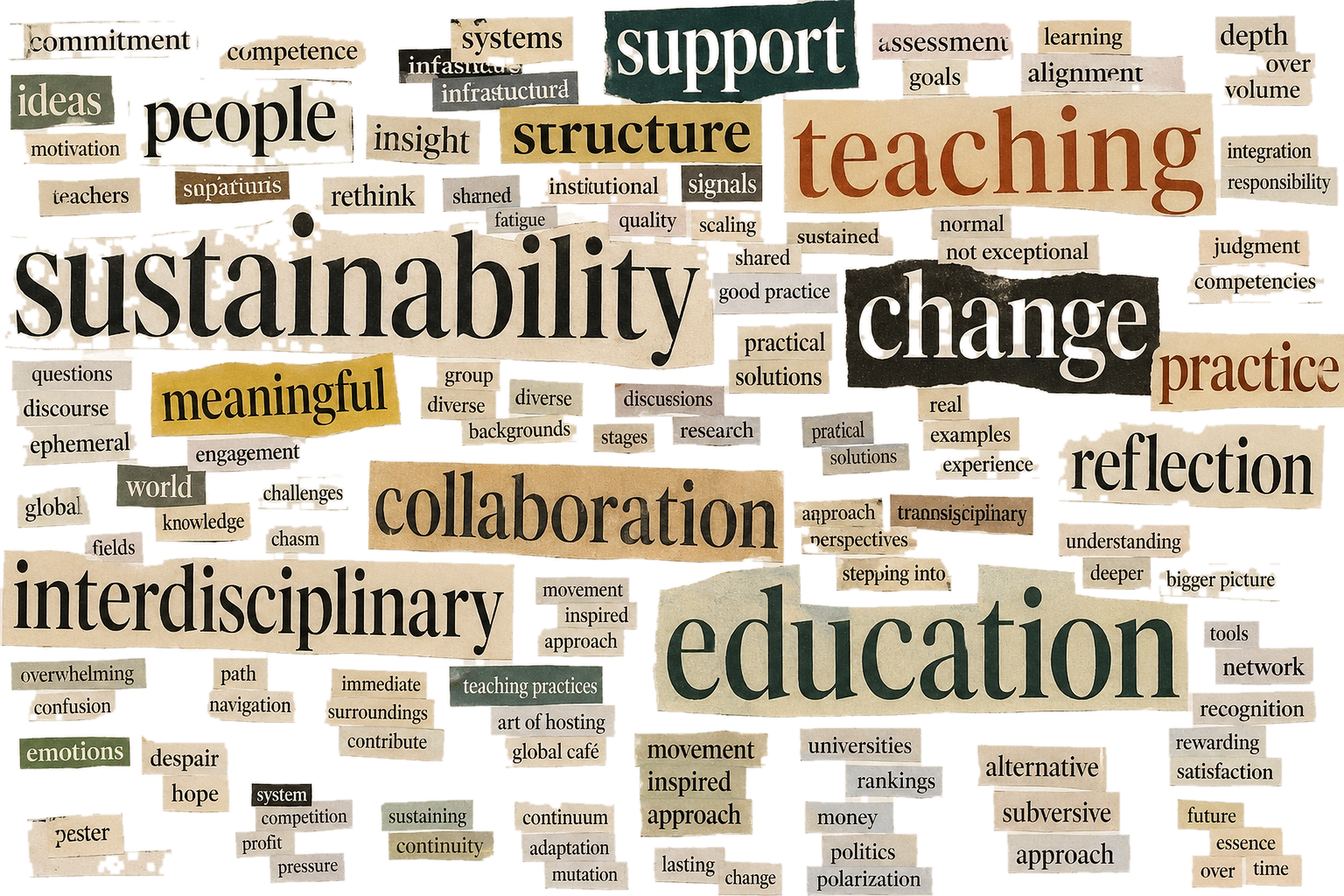
Word cloud of key themes: sustainability, education, pedagogy, structure, responsibility, practice, commitment
💡

Insights

A recurring insight from our reflections is that meaningful change in higher education cannot rely on individual teachers acting heroically within unsupportive systems. Many colleagues already possess the commitment, competence, and pedagogical ideas needed to teach for sustainability, uncertainty, and societal responsibility. What is often missing is not motivation, but structure.

At the same time, the key to meaningful engagement with sustainability comes from interdisciplinary beginnings. Mind-forged manacles of disciplinary coherence have caused a chasm that not only separates fields of knowledge but also the very questions we dare to ask. A problem that threatens the whole world demands the attention of the whole world.

When sustainability-oriented teaching depends on personal enthusiasm, extra hours, or informal workarounds, it becomes fragile and uneven. Over time, this not only limits educational quality but also contributes to fatigue and burnout. Supporting teachers structurally therefore means shifting attention from individual effort to shared infrastructure: time for collaboration, assessment practices that align with stated learning goals, pedagogical commons that reduce duplication, and institutional signals that value depth over volume.

If we want education to foster judgment, integration, and long-term responsibility, these must be normal, and supported, ways of teaching, not exceptional ones. Structural support enables good practice to be sustained, shared, and scaled, while reducing the need for individual heroics. In this sense, supporting teachers structurally is itself a core sustainability commitment.

Sustainability is not simply a matter of content but could and should permeate teaching and learning and the competencies students develop.

🚀

The Ride

The topics were well organized and the resources were very useful. The time allocated for each topic also gave us enough space to dig into different parts. Working together—reading and reflecting with others—was a rewarding experience at the same time.

Being a small group of people from different disciplinary backgrounds, and at different stages of research and teaching careers, was instrumental in getting over the initial overwhelming sensation brought on by the abstraction of sustainability. Our group managed to both discuss sustainability as an ephemeral notion that permeates the world and also ground it with real examples from our situated experiences in academia, allowing us to move toward practical solutions.

The differences in our fields and the different places we came from added real value to our group discussions and created many interesting branches along the way. One important resource was the varied background of participants. We moved from our narrower fields to more general ideas, discussing details and sharing experiences.

❤️

Feelings & Experiences

We mostly started with an overwhelming feeling and a lot of confusion, but very soon we found a path and learned how to navigate it. We managed to address very practical issues, and through many comparisons we often realized that even when we felt sure about something, we could push each other to understand deeper relations and the bigger picture.

On an emotional level, there were also moments of despair, where it felt as though we were trapped in a system that prioritizes competition, profit, and narrow definitions of usefulness, making meaningful change seem distant or even impossible. This feeling was gradually mended through our discussions on how change can begin within our immediate surroundings and practices.

Many times we supported each other by stepping into each other’s disciplines and trying to see things through someone else’s eyes. During this process, we often felt rewarded and satisfied, and by the end we feel our time was spent very usefully—with many tools, detailed discussions, and hopefully a lasting network. In a way, these types of discussions call you out of your own depth and rekindle a willingness to contribute to change. A sense of recognition emerged, along with the ability to connect dots that had previously seemed incomprehensibly separated.

🌍

Imagine

Interdisciplinarity—or perhaps, transdisciplinarity—would be a given, perhaps an all-encompassing base course or base year; specialization would follow and would be characterized by varied, student-led and activating pedagogies and didactics that would promote an attitude towards education as an end in itself and a motor of profound social change.

🎒

Take-Away

Try to sustain the social movement-inspired approach to education in general, along with many specific ideas for conducting education in particular.

The written individual reflections of our group, and the online discussions through which these reflections merged and evolved into solutions, revelations, and sometimes new questions, will stay with us for a long time—not only the content but also the format. The value of interdisciplinary collaboration stands out as a key takeaway.

In terms of teaching practices, approaches such as the art of hosting and global café have already been introduced to colleagues, receiving a positive response.

Questions

Will sustainability education be able to sustain itself as an alternative, sometimes subversive, approach to education and the university in the face of strong opposing social forces? We still wonder whether this kind of approach can survive when there are strong pressures pushing universities toward rankings, financial incentives, and narrowly defined “useful” outcomes.

How can we bring sustainability discussions into our disciplines without students perceiving them as political impositions, especially in a polarized climate? Why did this course and our PBL group feel so different from other pedagogy courses—was it the structure, the group dynamic, or the interdisciplinary mix?

At the same time, how do we facilitate continuity when it comes to sustainability practices? Can lasting change be achieved so that when individuals or organizations championing sustainability move on, their efforts remain? Continuity is not simply about preservation—transformation and adaptation are essential, as ideas evolve with context. Yet this raises the question of how the core essence of sustainability can be carried forward over time.

Behnaz Pirzamanbin

behnaz.pirzamanbin@stat.lu.se

Sustainability through the lens of mathematical statistics

“Sustainable transformation therefore has to include sustainable working conditions for teachers, not only competencies for students.”

At the start of this course, I mostly thought of sustainability in higher education as a question of what we teach, adding climate content, the SDGs, or specific sustainability topics. I was not optimistic, but I was open to learning more. Over time, my learning shifted toward how knowledge is produced, taught, and used, and what kinds of habits and responsibilities education builds. This shift felt especially relevant in my own discipline: mathematical statistics. Even though it initially seemed difficult, the PBL format and the amazing group I was part of quickly made me feel excited and energized, and even pushed me toward seeing myself as a change agent.

One of my strongest learning outcomes is that sustainability can be embedded in statistical thinking itself. I began to see that statistics can be sustainable or unsustainable depending on how it handles resources, uncertainty, and long-term relevance. For example, the growing computational footprint of modern data science challenges the assumption that more data are always better. A sustainability lens makes me value sample efficiency and stopping rules, not only as technical preferences, but as responsible choices. Classic statistical ideas such as optimal design, efficiency, and bias–variance trade-offs can be reframed as sustainability principles: extracting meaningful information while minimizing unnecessary cost.

At the same time, sustainability in statistics is social and ethical. Statistical claims shape decisions that affect people and communities, often invisibly. If uncertainty is hidden, bias is ignored, or results are communicated with false confidence, we may gain short-term gain but lose long-term trust. This connects strongly to the course’s repeated emphasis on uncertainty and the need to live with a lively planet, rather than pretending the world is a closed system that can be controlled (Facer, lecture reflection). In my context, this means I will focus even more on teaching uncertainty as something students must communicate responsibly, not as a weakness, but as reality.

A second major learning point is that didactics for sustainability is not only about ideals; it requires alignment between goals, learning activities, and assessment. Wilhelm et al. (2019) helped me see how easy it is to claim we want students to become competent change agents, while still assessing what is easiest to grade. As a statistician, I recognize this as a measurement validity problem: we can produce very precise numbers that do not measure what we truly value. In sustainability contexts, students may correctly interpret coefficients and p-values, but still miss the larger questions of system boundaries, and confounding. This course strengthened my belief that constructive alignment is not only an administrative tool; it is also a moral tool because what we assess becomes what students learn to prioritize.

The competence literature helped me translate sustainability didactics into a statistics course. Sustainability competences such as intrapersonal, implementation, and integration, pushed me to see probability and inference as more than technical content: they train decision-making under uncertainty, and assumptions (Redman & Wiek, 2021; Brundiers et al., 2021). This also connects to a practical tension: transformation cannot rely on hero teachers working extra hours in unsupportive systems. If educators are expected to deliver transformative learning without structural support, burnout becomes a system signal that the institution is operating beyond its regenerative capacity. Sustainable transformation therefore has to include sustainable working conditions for teachers, not only competencies for students.

My learning will influence my practice in several concrete ways:

First, I will revise my introductory lectures: instead of only going through grading and content, I will explicitly introduce uncertainty, assumptions, and disciplinary language differences as part of learning.

Second, I plan to experiment with short participatory methods inspired by Art of Hosting (Quick & Sandfort (2014)). For example, before teaching regression interpretation, I can run a 10–15 minute Circle practice around a scenario such as: “A Green Commuting program reduced CO2 by 12%.” The goal is to host the question before modeling: what does reduced mean, what boundaries are included, what could bias the estimate, and what decision the analysis is meant to inform. This helps students connect statistical output to responsible reasoning.

Third, I want to develop assessment that rewards interpretability, reproducibility, and reflection on limitations, not only numerical performance. My “choice-based project” approach is one step: students choose among real-world and theoretical tracks, and must defend assumptions, diagnostics, and communication. However, I also see challenges: AI use, uneven group work, and a student culture that fears being wrong. My response is to redesign project: require transparency about tool use, use AI discussions, and document this process. Together with my HEDS group members, we will also try to run a study on this and, hopefully, report it as a scientific publication.

Finally, the course strengthened my view of the university’s role. Orr (1991) argues that universities cannot only speak sustainability; they must align words with actions and institutional incentives. Maniates (2017) warns that sustainability stays superficial if universities chase efficiency while keeping growth-driven incentives, so definitions of success must change—not only course content. Sustainability cannot be reduced to a theme week without daily support for teaching, and it cannot succeed without including students in changing norms and expectations (Hald & Hällström, 2011). In this sense, didactics for sustainability is also institutional didactics: the university teaches through what it rewards.

I end the course with motivation, and a question: how do we create space for sustainability conversations in our disciplines without being framed as having political agenda?

References

Erik Persson Pavlovic

erik.persson.pavlovic@kau.se

Sustainability didactics from Risk and Environmental Studies

“Sustainability, like risk, is ultimately about how societies choose to act under conditions where knowledge is incomplete, stakes are high, and consequences unfold over time.”

Participating in the HEDS course has reshaped my understanding of didactics for sustainability, not as a matter of introducing additional content, but as a question of how knowledge, uncertainty, judgment, and responsibility are pedagogically organised. Through the course, and particularly through the PBL work, I have become more attentive to the tensions between stated sustainability ambitions and the assessment regimes, time structures, and disciplinary conventions that shape everyday teaching. Sustainability, in this sense, is less about what is taught and more about how students are required to integrate knowledge, evaluate consequences, and make justified decisions under conditions of incomplete information. While our group reflection articulates shared insights and collective experiences from the PBL process, this individual reflection focuses on how those insights reshape my disciplinary understanding, teaching practice, and feasibility judgments as a teacher in Risk and Environmental Studies.

In the PBL group work, rather than smoothing disciplinary differences into a unified perspective, it became clear that sustainability problems are framed through incompatible assumptions about uncertainty, evidence, and action. Interdisciplinarity here functioned less as a means of synthesis and more as a pedagogical device for exposing epistemic limits and translation costs between fields. From the perspective of Risk and Environmental Studies, this reinforced my understanding of sustainability challenges as situations where coordination, negotiation, and judgment across perspectives are unavoidable. What the course clarified for me is that the pedagogical value lies precisely in these frictions, as they surface the conditions under which decisions must still be made despite persistent disagreement or uncertainty.

Another major learning concerns feasibility, not merely as a practical limitation but as a central didactic condition. Our PBL discussions repeatedly moved away from idealised models of sustainability education and instead examined what is viable within concrete institutional, disciplinary, and temporal constraints. From a risk perspective, this revealed how sustainability teaching that relies primarily on individual enthusiasm constitutes a structural vulnerability: such practices are fragile, difficult to reproduce, and highly sensitive to staff turnover or changing priorities. I have therefore come to understand structural support for teachers—notably through shared pedagogical resources, aligned assessment practices, and institutional recognition—as a matter of educational resilience rather than educational idealism. In this sense, sustainability teaching itself must be designed to withstand uncertainty and constraint if it is to be sustained over time.

These insights directly influence my own teaching practice. In my course “Pedagogical methods for teaching about risk and environmental issues”, students are required to develop, test, and evaluate a pedagogical method, often a serious game, focused on risk and sustainability challenges. Through the HEDS course, I have gained stronger conceptual language for why this approach matters. Action oriented learning, iterative testing, and reflection map closely onto sustainability competencies such as systems thinking, anticipatory competence, values thinking, and implementation competence. More importantly, they allow students to experience the tension between ambition and constraint: limited time, incomplete knowledge, conflicting values, and imperfect solutions. This mirrors the realities of risk governance and climate adaptation far better than traditional, solution oriented assignments.

My thinking about didactics for sustainability has also evolved in relation to values and normativity. Risk research often strives for analytical distance and objectivity, yet the course has reinforced that decisions about acceptable risk, protection, and responsibility are always value-laden. Teaching sustainability in risk-related fields therefore requires making these value judgments explicit rather than pretending they can be resolved by technical analysis alone. In practice, this means designing learning activities where students must justify decisions, articulate trade-offs, and reflect on whose interests are prioritised, without collapsing these discussions into either relativism or moral prescription.

As a result of my involvement in this course, I plan to make several concrete changes. First, I will further strengthen the alignment between learning outcomes, activities, and assessment in my courses, ensuring that what is examined reflects students’ ability to integrate analysis, judgment, and action. Second, I will expand the use of reflective elements, such as process reports and structured reflection prompts, to make learning under uncertainty visible and assessable. Third, I intend to work more deliberately with shared pedagogical structures, for example by developing reusable templates, scenarios, and assessment rubrics that reduce individual workload while supporting sustainability oriented teaching over time.

The course has also sharpened my attention to the institutional conditions under which sustainability education is expected to operate. Many PBL discussions revolved around the mismatch between transformative ambitions and growth oriented university structures. Drawing on concepts from risk governance, I increasingly understand this as a problem of scale and robustness: pedagogical approaches fail not because they lack vision, but because they exceed what existing systems can reliably support. This has led me to focus on what I would describe as minimal viable transformations: changes in teaching design that are modest in scope yet durable, replicable, and capable of shifting emphasis toward integration, judgment, and long term responsibility without relying on exceptional effort from individual teachers.

Reflecting on the course from my professional standpoint, I am struck less by the emotional journey of the process and more by how sustainability didactics can be designed to make complexity, uncertainty, and value conflict pedagogically productive. In sum, the HEDS course has deepened my understanding of sustainability education as a practice concerned less with transmitting correct answers and more with cultivating the capacity to navigate complexity, uncertainty, and ethical tension. For Risk and Environmental Studies, this alignment feels both natural and necessary. Sustainability, like risk, is ultimately about how societies choose to act under conditions where knowledge is incomplete, stakes are high, and consequences unfold over time. Designing teaching that enables students to engage responsibly with that reality is, for me, the central didactic challenge going forward.
Magnus Granberg

magnus.granberg@miun.se

Sustainability didactics from a sociological perspective

“Students’ prior knowledge and their sense that society as presently organized is fundamentally unsustainable must be the foundation of truly interdisciplinary sustainability education.”

My initial and perhaps most general insight from HEDS is that sustainability is not simply a matter of the content of teaching, as I assumed at the outset. Rather, sustainability should permeate teaching and learning and the competencies students develop. These competencies are the preconditions for fostering change-agents (Rieckmann, 2018) and, while they might not be sufficient for effecting radical change in themselves (Sterling, 2021), they are a step removed from specific contents and therefore general (Brundiers et al., 2021; Redman & Wiek, 2021). Hence, looking at the couple of competencies which are usually listed first in the literature—systems-thinking and futures-thinking—I think it is clear they can be applied to highly varied contents.

However, I also learned that sustainability became a force in higher education through a dialectic between the general and the specific, and this has shaped my thinking about sustainability education. This connects with the topic of change agency. If the impetus for such agency is to be affirmed and developed, students’ prior knowledge and their sense that society as presently organized is fundamentally unsustainable must be the foundation of truly interdisciplinary sustainability education (Hällström, 2011; Orr, 1991). Hence, the “general” in the sense of the interdisciplinary and global scope of present-day sustainability challenges links up with the “specific” contents that enter into these challenges. These specifics become the context of a new generality of sustainability education and research beyond disciplinary boundaries.

This means two things in terms of teaching. One is that students must be given the conditions to voice their prior knowledge and view of the world in ways that contribute to shaping the teaching and learning process. (I will develop this with reference to the art-of-hosting below.) Secondly, the content of teaching cannot be confined to strict disciplinary boundaries. As I teach classical sociological theories of modernity and the gloomy accounts of environmental destruction anticipated by both Weber and Marx, students will regularly press for alternative forms of societal organization, which I have oftentimes considered outside the scope of a strictly analytical science. But as texts by Maniates (2017) or the report we read on a society “beyond growth” (Hagbert et al., 2019) show, this kind of separation is in fact only reasonable within the confined space of sealed-off disciplines, wedded to conservative ideas about science and neutrality.

Therefore, it is necessary to revisit the arguments for an engaged—when necessary, politicized—teaching and learning process—in my field what used to be called a “public sociology” (Burawoy, 2005). There is a fine argument for this in Gustavsson (2011: 111) who explains that social movements have, since the end of WWII, sought “to unite science with a commitment to change”. Gustavsson locates the logical ground of this unity in the assertion that factually based and ascertainable propositions about the world make it rational to favor or oppose a value judgement (e.g. production should not be motivated by profit but by human and other ecological needs). In other words, statements about reality (science) are not sealed off from statements about the values we embrace or reject (ibid: 116).

So, when students press for alternatives and a “prognostic” knowledge on how to reorganize society and the world, they are invoking the first couple of competencies that I mentioned at the start of the reflection—systems-thinking and futures-thinking. They are taking a holistic, interdisciplinary approach that may push conversations towards economics and thermodynamics—but perhaps for the better!—and have us consider utopias and modes of social reorganization in the future. This must be affirmed rather than neglected; and I believe that I as a sociology teacher am otherwise spoiling the great resource that is an engaged student body, a privilege I have become conscious of through discussions in the PBL-group.

One concrete way that the experience of this course will influence my teaching concerns the “art of hosting” or AoH. While this is a set of principles that I have not previously worked with systematically, there are instances where these principles are already part of my teaching. In particular, this concerns the “harvesting” of conversations to devise future learning activities that allow students to influence the learning process. In the lectures I give, there are usually 45 minutes of traditional lecturing or monologue (although I encourage questions and comments of course). After a break, students discuss key themes in groups and come up with questions and reflections that prompt the remainder of the lecture. Here, I can gauge prior knowledge in the student group which can in turn inform the construction of subsequent seminars.

What I take from AoH, and especially from the “world café method” (The World Café Foundation, 2026), is the idea of organizing and embedding education in contexts where the content of education is affirmed as an end in itself and not instrumentalized.

References

  • Brundiers, K., Barth, M., Cebrián, G., Cohen, M., Diaz, L., Doucette-Remington, S., Dripps, W., Habron, G., Harré, N., Jarchow, M., Losch, K., Michel, J., Mochizuki, Y., Rieckmann, M., Parnell, R., Walker, P. & Zint, M. (2021). Key competencies in sustainability in higher education—toward an agreed-upon reference framework. Sustainability Science 16: 13–29. https://doi.org/10.1007/s11625-020-00838-2
  • Burawoy, M. (2005). For public sociology. American Sociological Review 70: 4–28.
  • Gustavsson, S. (2011). “Science and the commitment to change” in: Hald, M. (ed.) Transcending Boundaries: How CEMUS is Changing how We Teach, Meet and Learn. Uppsala: Cemus/CSD Uppsala, pp. 110–120. https://www.cemus.uu.se/wp-content/uploads/2015/05/TranscendingBoundaries.pdf
  • Hagbert, P., Finnveden, G., Fuehrer, P., Svenfelt, Å., Alfredsson, E., Aretun, Å., Bradley, K., Callmer, Å., Fauré, E., Gunnarsson-Östling, U., Hedberg, M., Hornborg, A., Isaksson, K., Malmaeus, K., Malmqvist, T., Nyblom, Å., Skånberg, K. & Öhlund, E. (2019). Futures Beyond GDP-Growth: Final Report from the Research Program ‘Beyond GDP-Growth: Scenarios for Sustainable Development’. KTH School of Architecture and the Built Environment.
  • Hällström, N. (2011). “What is education for?—The history of CEMUS” in: Hald, M. (ed.) Transcending Boundaries: How CEMUS is Changing how We Teach, Meet and Learn. Uppsala: Cemus/CSD Uppsala, pp. 14–31. https://www.cemus.uu.se/wp-content/uploads/2015/05/TranscendingBoundaries.pdf
  • Maniates, M. (2017). Higher education for a post-growth world. The Chronicle of Higher Education, June 12, 2017. https://michaelmaniatesblog.wordpress.com/wp-content/uploads/2014/04/maniates_higher-education-for-a-post-growth-world_12june2017.pdf
  • Orr, D. (1991). “What is education for? Six myths about the foundations of modern education, and six new principles to replace them” in: Gilman, R. (ed.) The Learning Revolution: Education Innovations for Global Citizens. Context Institute, pp. 52–59. https://www.context.org/iclib/ic27/orr/
  • Redman, A., & Wiek, A. (2021). Competencies for advancing transformations towards sustainability. Frontiers in Education 6: 1–11. https://doi.org/10.3389/feduc.2021.785163
  • Rieckmann, M. (2018). “Learning to transform the world: key competencies in Education for Sustainable Development” in: Leicht, A., Heiss, J. & Byun, W.J. (eds.) Issues and Trends in Education for Sustainable Development. UNESCO, pp. 39–59.
  • Sterling, S. (2021). Concern, conception, and consequence: Re-thinking the paradigm of higher education in dangerous times. Frontiers in Sustainability 2: 1–13.
  • The World Café Foundation (2026). “World café method”.

Burak Alp Cakar

burak.alp.cakar@liu.se

Sustainability didactics from a social semiotics perspective

“Interdisciplinarity is not a matter of choice but a necessity.”

The Key

If we are to foster, promote, vitalize, and sustain sustainably through education and make higher education sustainable, interdisciplinarity is not a matter of choice but a necessity. Katherine McKittrick once wrote “Discipline is empire” (2021, p. 33), arguing that segregation of ideas and knowledge systems upholds misery. Similarly, Orr (1991) argues that the university already possesses the knowledge to foster sustainability, but we are trapped in our disciplinary bubbles and an education system that focuses on shallow and narrow curricula rather than being a place of wisdom.

The path to sustainable education is rooted in interdisciplinarity. We should mend the rift between disciplines through meaningful collaboration or at least make an effort to hop out of our disciplinary bubbles to see how different scholars engage with sustainability. The HEDS course exemplified the importance of elasticity and porousness in our understanding of disciplines very clearly with its readings and the construction of the PBL groups. My group came from very different backgrounds, namely sociology, mathematical statistics, risk management, and linguistics. In our reflections regarding sustainability, we oriented towards these disciplines and attempted to relate and ground sustainability to our immediate surroundings. This was a daunting prospect at first, stepping outside of our comfort zones. However, it became one of the most important aspects of the course. It showed how certain disciplinary assumptions and boundaries can fetter the questions we dare ask. Attempting to synthesize sustainability with unfamiliar fields and domains further demonstrated the fruitfulness of inter- and transdisciplinary dialogue. As Nordén et al. (2026) argue, sustainability education cannot rely on a single disciplinary approach. Instead, meaningful progress requires transdisciplinary collaboration and being open to different ways of knowing and pedagogical strategies.

Sustainability Repertoire

When it came to expanding my sustainability repertoire, both the content and the format of the course worked hand in hand to deliver results. The written reflections, informed by the course readings, were then taken up during our twice-weekly group meetings and discussed collectively, which often led to new insights. Based on this, a recurring theme that permeated my thoughts was that sustainability cannot be reduced to isolated institutional initiatives or technical solutions. The discussions around CEMUS (Hällström, 2011) made it clear that student-led sustainability initiatives should not be treated as peripheral but as foundational in bringing about change. Similarly, Maniates (2017) argued that universities must move beyond efficiency-driven approaches and confront their structural dependence on economic growth by prioritizing well-being, equity, and ecological sustainability, while also deepening collaboration beyond academia itself through engagement with Indigenous communities, worker cooperatives, and community-based institutions. Keri Facer’s talk further expanded this perspective by emphasizing that sustainability also requires rethinking humanity’s relationship to the Earth itself. Rather than treating the world as a passive object to be dominated, Earth must be understood as a lively and complex system of which we are a part. Altogether, these discussions allowed me to contextualize sustainability in a much more nuanced and interconnected way.

Making Change

In terms of concrete takeaways and applications, I plan on implementing the world café method in my teaching of social semiotics, which is the study of signs and meaning-making in social contexts. A classroom discussion inspired by the World Café (The World Café Foundation, 2026) could be designed so that each table presents a distinct semiotic environment: different visual styles, objects, or written prompts. The room itself, being semiotically rich, could also be incorporated, including elements such as signage, recycling instructions, or spatial arrangements. Students could then be tasked with analyzing the signs they encounter, where they would focus on their social functions and the meanings they produce within specific contexts. This hands-on activity would pave the way for students to engage directly with semiotic processes and things about them more concretely, moving beyond abstract theory to embodied and situated analysis. This would foster many of the competencies stressed in the literature.

Beyond my teaching, I also want to disseminate the ethos of sustainability that I learned from the course to the department. I plan to create a shared repository of suitability-related resources in our online workspace where colleagues can access, interact with, learn from, and expand. My hope is that this can become a living repository that encourages more sustainable educational practices over time.

References

  • Hällström, N. (2011). “What is education for? – The history of CEMUS” in: Hald, M. (ed.) Transcending Boundaries: How CEMUS is Changing how We Teach, Meet and Learn. Uppsala: Cemus/CSD Uppsala, pp. 14–31.
  • Maniates, M. (2017). Higher education for a post-growth world. The Chronicle of Higher Education. June 12, 2017.
  • McKittrick, K. (2021). Dear Science and Other Stories, Errantries. Durham and London: Duke University Press.
  • Nordén, B., Ulvenblad, P., Mäenpää, A., Vogopoulou, A., Dourado, A., Merkisz-Guranowska, A., Lundberg, A. L. V., & Schiöth, H. B. (2026). The grateful eight: Perspectives on higher education affordances and tensions and didactics’ role in enhancing learning experiences towards sustainability. Frontiers in Education, 11, 1783112. https://doi.org/10.3389/feduc.2026.1783112
  • Orr, D. (1991). “What is education for? Six myths about the foundations of modern education, and six new principles to replace them” in: Gilman, R. (ed.) The Learning Revolution: Education Innovations for Global Citizens. Context Institute, pp. 52–59.
  • The World Café Foundation (2026). “World café method”.